



Being able to drive a car to get to work, earn a living or go on holiday comes with rewards and risks. Dashing across a busy street without understanding what might hit us, could be deadly. So, we keep ourselves safe by learning and following a Highway Code. We stop, look, listen and make careful judgements about when to cross. Navigating a busy road requires us to be alert and patient, whether we are a driver or a pedestrian.
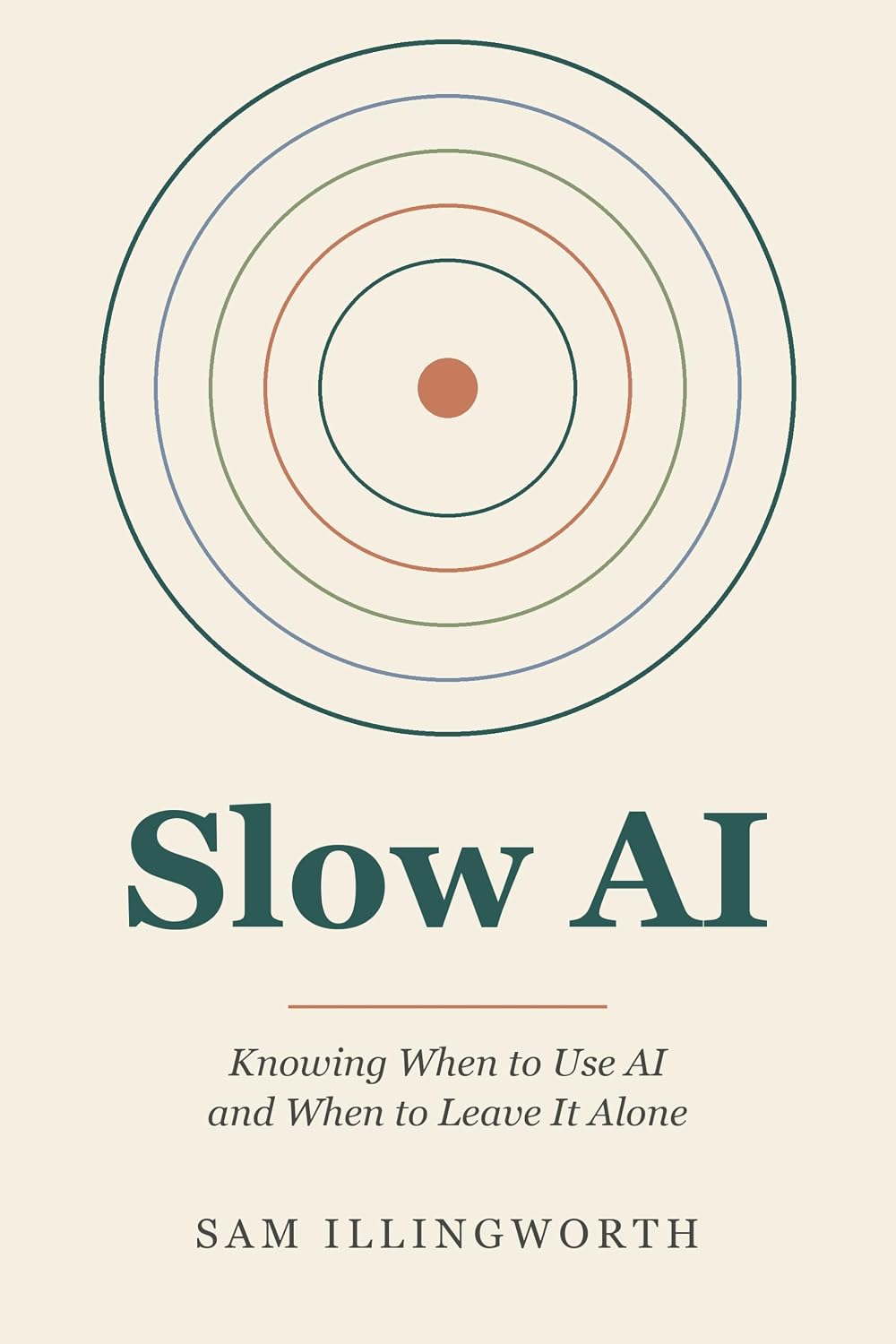
Now, we also have “traffic” in the form of Large Language Models (LLMs) such as ChatGPT and Chatbots. AI functions are becoming part of our lives, regardless of whether we choose to embrace them or avoid them. Slow AI: Knowing When to Use AI and When to Leave It Alone by Sam Illingworth PhD is like a highway code of valuable points to help us navigate through AI’s pros and cons.
If you disapprove of this new technology, you will certainly find facts, stats and incidents confirming your suspicions. But there’s more. And it’s worth reading, because we are all affected by this new landscape of highway-sized hazards and havens, as it charges and changes (both “it” and “us”) almost minute by minute.
Slow AI has 7 chapters:
- AI is not your friend
- Good AI is excellent
- AI can save you time, and it can cost you time
- AI is designed to hold you
- AI detection does not work
- The ecological cost of AI
- The humanities are the moat.
It encourages us to be alert and GO SLOW. Each chapter ends with a poetic pause for thought: a sanctuary, encouraging us to “read between the lines”. That’s something that AI can’t do! It’s a quick easy read, packed with enlightening, sensible and surprising AI-related information. Primarily aimed at higher education students and faculties, it is still relevant for all and minimally priced for broad use. I particularly appreciated its wisdom as a writer and author.
Sam Illingworth explains his book is only available as an eBook because it will need to be progressively updated. I’ve been following his posts on LinkedIn and found a recent blog about an author having his trade publisher contract withdrawn due to their suspicions that his story was created by AI.
“To AI or not to AI” is no longer the question writers need to ask. Instead, it is “To PROVE or not to PROVE that AI was used … and how it was used”. Barrelling down this latest Tech Highway, it appears that we are all labelled guilty unless we can prove otherwise … at least until AI Detectors such as Turnitin are overturned and a better way of establishing how to tell the difference between human-created and AI-created prose is realised (if that’s even possible).
So, to all my writing friends, using AI tools or not, from now-on, please remember:
- Treasure that first rough draft (preferably hand-written).
- Keep the messy second and further versions with time-stamps.
- Log any AI use along the way, showing that you are boss of your team!
- Don’t give up your ideas to a Cloud without being prepared to fight.
Even if you aren’t going to be a famous author for another ten years, it is still in your best interests to cherish all your own words through to “happily ever after”.