Subscribe to Blog via Email

Enter your email address to subscribe to this blog and receive notifications of new posts by email.

Reaching out to Pluto

I love Pluto

Join the PLUTO FAN CLUB!

Launched in 2006, the New Horizons spacecraft flew past the distant dwarf planet Pluto on 14th July 2015.

The information New Horizons will send back to Earth over the next year or so should get everyone excited about Pluto & other objects in the Kuiper Belt, and will ultimately add to our understanding of the whole Solar System.

NASA posts videos about the New Horizons venture here. “Seeing Pluto in a New Light” is over an hour of interviews with the main scientists, but it’s where I learnt the information below. There will be a new video about Pluto on Friday 24th August.  (Most of the other videos are short.)

Pluto is an isolated small planet showing geological activity (possible geysers and volcanoes), because it doesn’t have lots of impact craters (whereas our Moon has plenty of them). Triton, orbiting Neptune, also has few impact craters. Astronomers though that Triton’s geological activity (such as the tidal energy Earth experiences from the Moon) was because the giant gas planet Neptune’s gravity is pulling (tugging) on Triton. But there is no giant gas planet near Pluto. So this week we have learnt that a small solitary dwarf planet, far far away from the heat energy of the Sun is capable of having something like a warm centre with energy that can create volcanoes or geysers (or something similar) to make its surface cover over any crater holes.

This ABC News article has some great photos and a very helpful half-minute video at the bottom:

The bedrock of Pluto’s mountains must be made of water-ice rather than rock. Pluto seems to have a nitrogen-ice coating (frosting). Pluto is losing lots of nitrogen gas from its atmosphere into space. So there must be a way nitrogen is being released from the planet’s insides, possibly from geysers and or volcanoes. Is Pluto farting nitrogen?

American, Clyde William Tombaugh, discovered Pluto, so the scientists want to name the heart shaped region after him (Tombaugh Regio).

Sometimes it is the silly things like this issue with Disney’s cartoon character Pluto, that help us remember names. It may also be why some of us love to hear about the planet Pluto!


A POETIC ANGLE: Are we in love with Pluto?

Pluto has a smooth heart-shaped icy-bright area on its surface. Pluto has also amazed scientists by having some kind of geological activity going on inside it. This means it ought to have something warm inside … like a heart!

RAINBOWS making poetic waves

Can you write a poem about science for National Science Week? Tahya from Whitfield State School has started the countdown with her poem RAINBOWS (below).  Students in Cairns are helping Science Rhymes poet Celia Berrell create a collection of verse for this year’s National Science Week (themed Making Waves: The Science of Light).  And this is an invitation for you to have a go too!

A4 NSW Poster image small


RAINBOWS  by Tehya

Rows of ripe colour spread through the sky
The look so extraordinarily high
Sometimes vibrant and crystal clear
But often faded and not so near.

When rain clouds clear, the sun shines bright
Then raindrops are dazzled by the light
Which first refracts, then reflects on each drop
As a spectrum of colour bursts with a pop.

Some think that rainbows hold magic and mystery
Myths about gold were believed throughout history
Races on rainbows?  Now that can’t be right
It’s simply the wonderful science of light.

There are nine weeks left for you to pen your poetic piece as we count down to blast-off!

Lasers

Lasers are a relatively new light technology that has a fantastic reach of applications.  From surgery to entertainment, it helps us cut, weld and have sensational fun.

  1. We can trust NASA to provide a clear explanation to the question What is a laser?
  2. The BBC UK provide a written explanation for year 10 students in their bite-size series.  This may be easier to understand if you check out the NASA explanation first.
  3. The first one minute cartoon on this Planet Science page explains why photons are happy to travel together in laser beams.
  4. Scienceline gives us some laser history.

laser show

Did you know there are competitions to create the most spectacular and complex light shows with lasers?  This You Tube video was posted by Dynamic Lasers.


Bioluminescence

Most of our planet’s bioluminescent creatures live in the oceans.  And the deeper down we go, the more we are discovering!

  1. Firstly, let’s clear up any confusion about muddling bio-luminescence and bio-fluorescence with this helpful webpage from Luminescent Labs.
  2. This National Geographic video is about a team preparing to search for a giant squid, but has some illuminating examples of bioluminescence in the sea at night.
  3. Marine Biologist Edith Widder starts her TED talk by inviting us on a trip to an alien world; a place defined by light.  And below is one of the images she’s captured – a bioluminescent midwater squid.

Midwater squid by E Widder

One day, we hope to discover life on other planets and moons. Jupiter’s moon Europa may have a hidden sea under its icy crust.  Could it be home to alien bio-luminescent life forms?  Sci-Fi artist Rob Powell imagines the possibilities with his image of a Europan Dragon – Dracolestia xengola!


Iridescence

If you’re looking for some inspiration to help write a poem about the beauty of iridescence, here are some helpful links:

  1. You’ll need 10 minutes or so to watch this excellent science lecture for children.  Here’s Beetles Bubbles and Butterflies: The Origins of Iridescence from the Science Bag – University of Wisconsin, Milwaukee, USA.
  2. Or try this page from Yale Scientific which explains what causes iridescence including some vivid photo examples.
  3. How Stuff Works has a diagram about getting the right light wavelengths to create iridescent colours requires two surfaces that reflect light waves in a constructive interference pattern.
  4. Live Science suggests that some insect iridescence helps confuse the animals trying to eat those insects.  Many birds, such as the peacock (image featured) boasts how fit they are by having iridescent feathers to help them lure a mate.
  5. The shapes and surface patterns of butterfly wing scales are what create their iridescent colours.  The Daily Mail UK shared these detailed photos, one of which is displayed next:

iridescent butterfly wing scale


Finally, Live Science reveals that even some feathered dinosaurs had iridescent colouring too!


Earth’s Auroras

In yesterday’s Poetry Club presentation about “The Science & Poetry of Light” at Whitfield State School, we read out the Science Rhyme Aurora Borealis.  The Earth’s Auroras are sensational examples of excited electrons emitting photons of light.

This is my favourite collection of Northern Hemisphere Auroras

This Aurora Australis was shot from the southern tip of New Zealand.

And finally, a red Aurora Australis from the Red Centre – Uluru!


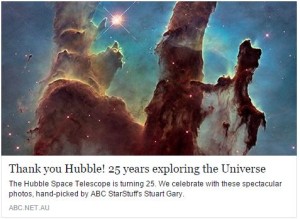
Happy 25th Hubble Space Telescope!

This year the Hubble Space Telescope turns 25 and we are having a ball viewing the light from distant stars, nebulae and galaxies.

LIGHT IS …

Mysterious and magical
so dazzling and colourful.
Travelling through space and time
LIGHT MAKES the cosmos beautiful!

Thanks ABC Science for selecting some sensational Hubble photos for us to view.

ABC Hubble photos


Click here to view a fantastic video of the Pillars of Creation too.


2015 International Year of Light

Looking forward to a bright New Year?  The United Nations has declared 2015 to be the International Year of Light and Light Technologies.

Researching an old light technology resulted in the poem:

“Stepping Into The Limelight”

stage lights 2


which has been featured as the first poem of the year for Ripple Poetry.

Please check it out and have a Brilliant 2015!


Your SPACE Poems 2014


The Spectacular Solar System by Tahlia
(Trinity Anglican School, White Rock)

Neptune is furthest away from the Sun.The spectacular solar system
It’s extremely cold but still seems like fun.
It has faint, faint rings
and other cool things
like weighing more than a tonne.

Uranus is a giant ball of gas
which has a mega, mega mass.
It is number seven
and looks like heaven.
It would be a dream to go past.

Saturn is the second largest.
Its radiant rings are the best.
It is very cold
and I have been told
that it is way, way better than the rest.

Jupiter has dusk and dawn
ever since the day it was born.
It has a red dot
called the great red spot
which is a huge, huge wind storm.

Mars is a cold, cold desert.
However, it could be pleasant.
With rust in its surface
to mine for a purpose
we’d soon have a fabulous present.

Only Earth is a planet with water
which takes up just more than a quarter.
With heaps of things living
dancing and singing
some creatures are taller, some shorter.

Venus is so very hot.
In size, it’s like Earth quite a lot.
It looks bright at night
like an LED light.
Is 400 degrees hot or what!

Mercury has almost no air.
No human could breathe over there.
It is awesomely dry
like a cloudless blue sky.
I think I’ll learn more stuff to share!


Our Gas Giants by Bea
(Trinity Anglican School, White Rock)

There are four gas giants.  Jupiter is one.Our Gas Giants
But to stay up on Jupiter would be no fun.
Its Earth-sized core is extremely hot.
But its freezing clouds are certainly not.

A bit further out lays the beautiful Saturn.
It’s yellow and grey with rings forming patterns.
When seen through a telescope, Saturn appears
like a shiny round head with a pair of ears!

Uranus is next.  It’s the coldest around.
Like a marble rolling along the ground
it orbits our Sun, side-ways on.
Winter lasts 42 years long!

Then far, far away is a mysterious place.
Methane gives Neptune its stormy blue face.
So there, now you have it.  They’re gas planets four.
They’re the furthest ones out.  But there might be more.

These giants are cold.  The sun reaches barely.
Made of gasses and dust, could life survive?  Scarcely!


Space And Beyond by Charlotte
(Trinity Anglican School, White Rock)

Did you know that we live in a curious place?Space and beyond
The universe, which you know as Space.
There are trillions of planets like Earth and Mars.
Also billions of suns which we know as stars!

Now in the Space is the Milky Way.
Our Sun lives here, which we see every day.
At six thousand degrees on the outside, our Sun
would turn you to ashes in 1-2-3 done!

Last but not least is Earth, our home.
There may be life on Earth alone.
But nobody really knows that’s true.
I think it’s a fact, but how about you?


The Fantastic Solar System by Taliah Rose
(Trinity Anglican School, White Rock)

What planet is grey and yellow and has rings?
I believe it is famous for its icy flat rings in several groups of strings.
Have you guessed this planet yet?
Are you part of the Saturn set?
When you look high in the sky, it sparkles with bling.The fantastic solar system

Venus is the second hottest planet of them all.
It is the second farthest from the sun and is quite tall.
It’s yellow too.
You would need 38,000 km of kangaroos.
It’s also the same size as Earth, the only place you use phone calls.

Mercury is the closest to the hot exploding bright Sun.
I would go there just for fun.
Did you know its atmosphere has almost no air?
You couldn’t possibly get there unless you got dared.
I’m sure it weighs more than a ton.

Have you ever heard of the black hole?
It’s rather scary when you’re told.
It sucks you in
and stretches your chin.
But don’t be scared.  It’s wrinkly and old.


Terrestrial Planets by Lucian
(Trinity Anglican School, White Rock)

The Solar System is filled with planets and stars.
Especially terrestrial planets like Mars.
There are also gas giants like Saturn.
And the Milky Way has a dotty pattern.

The Sun is so very scorching hot.
If you landed there you would fry a lot!
Mercury is very small
and it almost has no air at all.Terrestrial planets

Venus has clouds that reflect sunlight.
Creating a light in the night that shines bright.
Earth is our planet and home which we live on
with a moon that weighs more than fifty tonnes.

Looking like it’s covered in rust
there’s a rocky clump of blood-red dust.
Fourth from the Sun, it’s the planet Mars.
And after that, it’s off to the stars!


Your Poems 2014

There’s an environmental thread through these poems.

Rainforests by Ava
Whitfield State School

Rainforests: beautiful, lush and green.
Bursting with wildlife, a treat to be seen.
One bird starts to chirp an amazing song
then all other birds start to sing along.
A shiny green tree-frog has climbed a tree
as bush bees fly round very happily.
Owls and bats roam in the night.
They’ll not let prey escape their bite.

To figure out their current location
bats use precise echolocation
while owls can see in very low light.
Their vision’s right for sight at night.

And when the night turns back to day
diurnal creatures start to play.
And once the birds begin to cheep
nocturnal creatures go to sleep.

Rainforests: beautiful, lush and green.
This place full of trees is a treasured scene.


Oceans by Sian
Whitfield State School

Beautiful oceans, sparkling blue
so many creatures depending on you.
But sadly pollution is taking them down.
Our oceans fine beauty is starting to drown.

It’s not just pollution that’s causing some harm
but also the atmosphere getting too warm.
As icebergs start melting the sea levels rise.
Pollution solutions we need to revise!


Kelsey May is a spoken word poet and literary student at Grand Valley State University in Allendale, Michigan USA.   Her first book of poems and essays is titled Adrift.

You&aGlobe  by Kelsey May

Let your fingers explore the wonderful
crevices of the globe, sitting aside pen holders,
paper cups, things made of the earth. Your fingertips
smile at the notion that they can “see”

such wonders as the Grand Canyon, Sahara Desert,
Atlantic Trench, all while lifting a mug of cocoa
to your lips, adjusting the volume on
your shuffled playlist.

The leaves will brush up against
the windowpane, then kissing their glossy skin
to the lightsource like insects. Do plants ever feel

cold? You’ll shudder a glacierwide dread, counting
your blessings that you aren’t spending the night
beneath a bridge. But that would never have been

you anyway. Your fingers will find the Pacific Ocean
and think nothing of the plastic island as big as Texas.


Linda Poon is an undergraduate at the State University of New York (ESF) where she is studying ecology. She lives in Brooklyn with her cat and piano.

Cellular Life by Linda Poon

Isn’t it beautiful
that we are made of cells?
So simple, yet so complex
so small and yet so powerful.Onion cells by Asagio from morguefile

Busy inside us
replicating, dividing
regenerating
growing at a rapid pace.
Supplying us with energy.
Giving us life.

So simple, yet so complex.
A myriad of cells
interacting with other cells.
All united in one.


Merrissa shares her love of physics, chemistry, astronomy and everything mysterious with her two daughters.  Her passion is creating glow-in-the-dark jewellery with her husband at Clover 13 in Texas USA.

GravityAll’s Fair In Earth’s Gravity
by Merrissa Sorrentino, Grand Prarie

Here is a lesson you won’t learn in class.
A gravity concept that leaves out the mass.
So pull out some paper and start taking notes.
There’s a moral inside that is getting my vote.

Gravity acts on us all as the same.
It doesn’t point fingers or play silly games.
We all hit the ground with the same exact speed
if we fall the same height.  No-one gets in the lead.

The black and the white, and the shades in between
are treated as equals.  The way it should be.
Light as a feather or heavy in weight
nobody comes in a second too late.

The good and the bad, the large and the small
they all become weightless when in a free-fall.

It doesn’t have favorites, or need to choose sides
a fact that can be easily verified.

The point of this lesson should be crystal clear.
I think that you know what I’m getting at here.
Stripped of our differences, one thing remains.
Deep down inside, we are all just the same.


Farther into the unknown
by Merrissa Sorrentino

Life is the question.  The answer, a riddle
But somehow we always get stuck in the middle
A complex emergence encrypting the code
The farther we wonder into the unknown.
Is it hidden somewhere in our “junk DNA”?
Or deep in the wrinkles inside of our brain?
Does gravity hold the answer inside?
Twisting and warping our view of space-time?

We sift through reality, lacking adhesion
Searching its matrix with no rhyme or reason
With each door we open, two more may appear
So answers become complex and unclear.
Uncertainty certainly plays a big role
By setting a limit on what can be known.
I assume this is how the rabbit-hole deepens
Just as we thought we were close to completion.


Celia Berrell
PO Box 830
Hervey Bay QLD 4655

Email:
feedback@sciencerhymes.com.au
Mobile:
0408 069 192
website by Precedence