Do you care about the ecosystem? I do! My name is Harmonie Larsen and I am the “founder” of the Mangrove Army. This is an organization that takes care of mangroves by looking out for illegally removed and damaged mangroves.
We are ordinary people with a difference – we care. We want to help out however we can. We want to get Mother Nature back on her feet, and we are doing this because we can.
You can join the Mangrove Army by sending in a report about a damaged mangrove, a bare bank or someone illegally removing mangroves. The Mangrove Army does not require payment to be a member, just commitment to keeping a lookout for damage to our ecosystem.
Mangrove Army by Harmonie Larsen
Long, winding branches reach for the sky
Like tall spindly animals stretching their necks
Mangroves that sway with the slightest of breeze;
these are the trees that we try to protect.
We need a group that will strive to defend
These beautiful, perfect and delicate trees
For they are important, they’re crucially vital
They are the plants that everyone needs.
So the Mangrove Army must work to protect
These trees that are so important for all
They protects our animals and cover our banks
We need your help – so answer the call …
Harmonie presenting her Mangrove Army concept to an audience at James Cook University in 2015
We used to think space and time were two separate things … until Albert Einstein challenged our common sense with his Theories of Special Relativity and General Relativity. He declared space and time are inseparable, creating a four-dimensional “fabric” made from three dimensions of space, and a fourth dimension of time.
Einstein gave us his Theory of General Relativity in 1915, but it has taken decades to prove his theories about space-time. Back in 2007, NASA’s satellite Gravity Probe B showed that the Earth really does distort the fabric of space-time.
Imagine the Earth is a big marble, sitting on a rubber sheet (representing four dimensions of space-time). The Earth-marble’s mass makes the stretchy fabric sag in the middle. A smaller Moon-marble trundling by, gets drawn towards the lower parts of the space-time fabric. Instead of travelling straight past, it curves into an orbit round the Earth. But imagining is not the same as proving. That takes clever tests and measurements.
So what happens to this space-time fabric when the Earth is spinning? Einstein suggested this would cause GRAVITATIONAL WAVES, little ripples in the space-time fabric. Well, last September we found one! It’s only recently been announced as scientists had to carefully check their data first.
They discovered a series of eight gravity waves (caused by two huge black holes spinning around and into each other) by using lasers and mirrors at the Laser Interferometer Gravitational-Wave Observatory. LIGO is a system of two specialised telescopes. Instead of detecting light, they detect gravity waves. One of LIGO’s detectors is in Louisiana, the other in Washington USA.
Scientists and Einstein fans know that LIGO’s gravitational wave proof is a fantastic milestone for science. And will probably lead to new technologies, as well as enriching our understanding of the universe.
To celebrate poetically, here’s Gravity Waves and a link to The Gravity Poemby Cassy Lawrence with a video, courtesy of HSE Docs UK.
Gravity Wavesby Celia Berrell
(Einstein’s right again)
Time and space
like warp and weft
of cosmic fabric set adrift
should bend for mass
by theory
of General Relativity.
Laser beams
at LIGO’s base
have captured
distance changing pace.
A travelled length
in altered time
means gravity gave us a sign!
So LIGO’s proved
how gravity
(that force of massive
mystery)
can kink and ripple
space-time’s shawl.
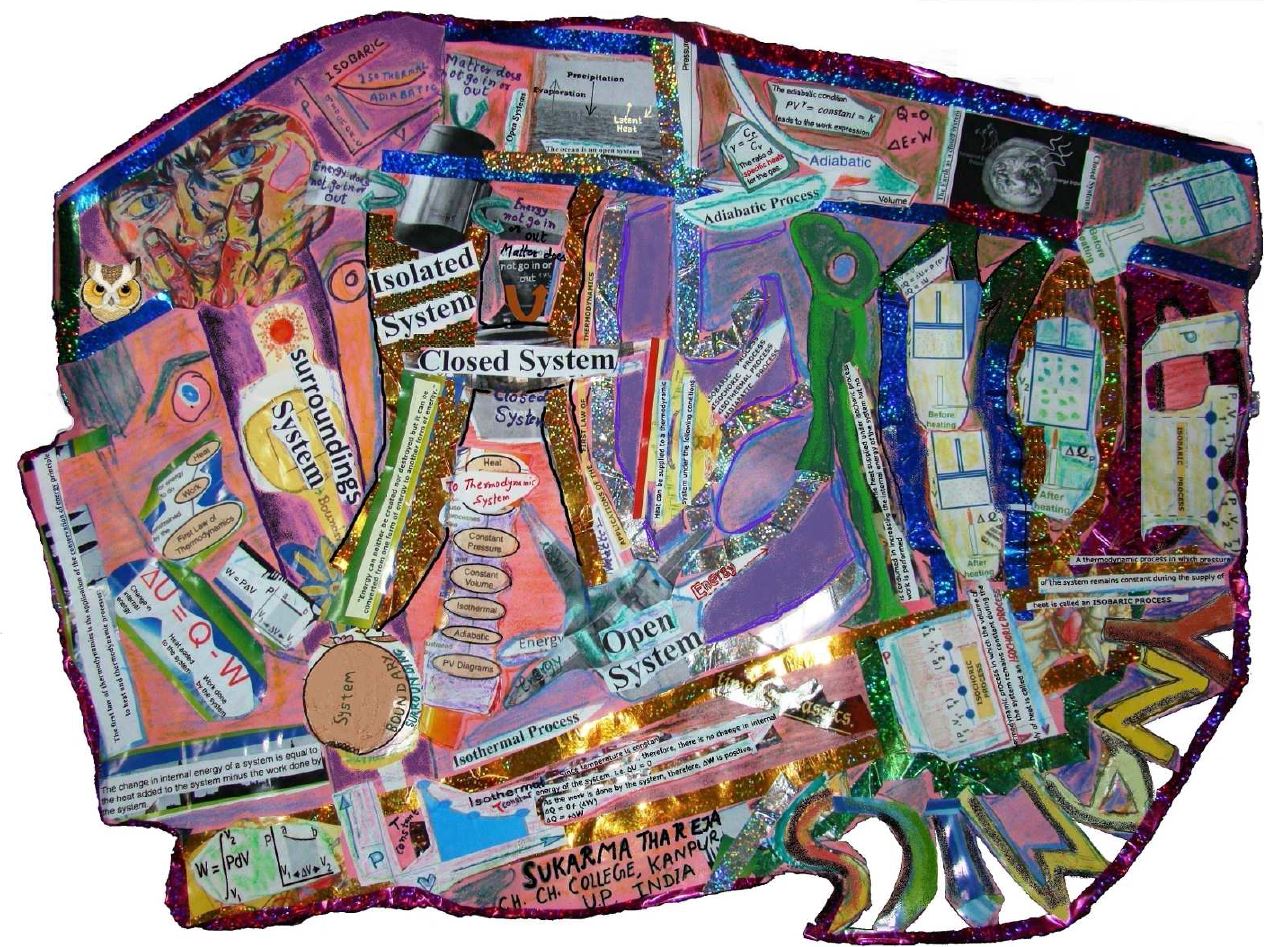
The Mahabharata is the longest known epic poem, written in Sanskrit around 400 BCE. In Indian culture, it is a revered text of historical and philosophical importance. Associate Professor Sukarma Thareja of CSJM Kanpur University, India, suggests our understanding of thermodynamics is no less significant than a work such as the Mahabharata.
Specialising in Physical Chemistry research, she is a fellow advocate of sharing science through poetry and visual arts. We are delighted to feature her free-verse poem and accompanying road-mind-map collage image and invite you to take Sukarma’s poetical journey into the world of thermodynamics.
(to view an enlarged version of Sukarma’s road-mind-map, click: corr Thm coll)
Thermodynamics by Sukarma Rani Thareja
Thermodynamics is all about
Flow of heat, into and out of system
As it undergoes physical/chemical transformations.
Thermodynamics lets us know; if particular
physical/chemical changes can occur
Under a given set of conditions.
In thermodynamics, there are three laws empirical.
One must learn all
To become an innovative physical chemist.
Boundary and surroundings are environment of system.
A diathermal boundary-wall provides no insulation (to system);
Adiabatic process won’t allow heat to flow in or out (of system).
Three thermodynamic principles
Are source of my inspiration
As a student of chemistry.
Understanding them is my passion
Since I have to learn them on my own
Therefore I need to make clear
Road-mind-map of these principles.
Where does heat energy move?
Heat energy is always moving towards a state.
Concept of state we can’t abbreviate.
When two systems are in contact
And the temperature of one (system)
Is uniform and same to connected system
Thermal equilibrium is said to be attained by two systems.
When the state variables have constant values throughout (the system)
Thermodynamic equilibrium is said to be attained (by the system).
First law of thermodynamics determines internal energy (of system)
By taking difference between heat and work (of system)
Thermodynamics attempts to explain by its second law
Why energy always moves from high to low.
Why are we not able to reverse the flow?
There is increase in randomness: entropy
Is answer to this important query.
Zero is the total change in entropy (of system)
Plus surrounding: for a reversible system.
But can we do work against increase in entropy?
Yes. But in doing so, we put a drain on some energy.
As scientists, we are looking towards perfect model.
Value of entropy is zero at Absolute Zero for a perfect crystal
But with finite number of steps
We can’t reach Absolute Zero – a temperature which is so magical
This is what the laws of thermodynamics tell us.
Finally, it seems we have reached our goal
Recollecting – learning three laws – empirical
by making mental-map-road.
Was that as easy as it looked before?
This masterpiece on thermodynamics
This literary humble poem, by Sukarma Thareja
May not be as worthy as epics of Mahabharta.
But it is surely no less than
The epic struggle of Bhisham Pitahma in Mahabharta.
You can now enjoy browsing through the photos and poems from our afternoon of poetry recitals by local student authors by clicking on the blue writing below:
We have two talented Picture-Book author/illustrators sharing their stories!
Cairns-based author Diane Finlay published “The Duck With No Quack” in 2006. It is about a duckling called Oswald who seems to have lost his quack. His Mama sets off in search of Oswad’s quack while her babies are having an afternoon nap.
Mena Creek artist Jacque Duffy published a series of children’s books starting with “That’s Not A House” after Cyclone Larry devastated her home near Innisfail. She will be sharing her latest book, “The Bear Said Please”. A very hungry bear looks everywhere for his favourite food. He learns how to find it and the best way to get it.
Bring your favourite picture book to the event, so we can photograph them together and see which ones rock.
We will be at the Poolside Patio, Rydges Tradewinds Hotel, 137 Esplanade, Cairns. Storytelling and Poetry recitals will be from 2pm to 3pm.
This event is a great opportunity for young poets and future authors to meet with well-established writers with a question-time session after the presentations.
Hosted by Science Rhymes poet Celia Berrell, with generous support from Rydges Tradewinds Hotel.
Please email celia@sciencerhymes.com.au to confirm your attendance and /or ask any questions about the event.
Click on the blue writing above to download a visually rich 32 page (3MB) presentation of poems and science concepts about light, which takes about 12 minutes to read. It is the culmination of a three month project, between Science Rhymes author Celia Berrell & Whitfield State School students (9-11yrs), to share the science of light which inspired them the most. We hope you enjoy it!
Including poems about light to celebrate the International Year of Light and National Science Week.
Twinkling Stars by Harmonie
Whitfield State School
Flickering starlight in the night.
Impossible to miss.
Although it seems natural
it wasn’t always like this.
A star is oh, so far away.
Immensely far from here.
Before that light can reach our eyes
it passes through our atmosphere.
Different densities of air
can change the view of starlight’s place.
Its light is interrupted here
compared with outer space.
The twinkling light of a far-off star
is only an Earth-bound view
as stars themselves don’t twinkle.
And now you know that too.
Bright Shiny Rays by Coco
Whitfield State School
What’s never murky or blurry
and couldn’t be foggy or dreary?
What’s ever so bright and full of colour
happy to shine on a polished mirror?
It’s light, illuminating our world
in glimmers and gleams both new and old.
Refracting, reflecting and being absorbed
light gives us life, and light is adored.
Bioluminescence by Harmonie
Whitfield State School
In the deep dark seas, a light shines bright –
from what, we do not know.
A white-lit glow in dead of night
holds terrors far below.
An anglerfish’s light will show
its jaws, thrust open wide.
And smaller fish, struck by the glow
swim foolishly inside.
How does its light, as bright as day
occur so naturally?
If you don’t know, then I’ll explain
and then we all will see.
Some luminous bacteria
(their light is hard to miss)
are helping deep-sea anglerfish
via symbiosis.
The female angler has a spine
on which bacteria sit.
Their microbe-hostess doesn’t mind.
In fact, she’s proud of it!
Bacteria provide the light
that lures the angler’s food.
And in return those microbes will
get shelter from the gloom.
The two live out connected lives.
Both working hand-in-hand.
Until the fish, without a fight
is caught and brought on land.
Light Duties for a Photon by Ava
Whitfield State School
Photons who are unemployed
but keen, hardworking, bright
we’d like you to be part of
a brand new ray of light.
To be a working photon
you’ll set the world aglow.
Helping plants to make us food
so we can live and grow.
You have to be a lightweight
move quickly, still be calm.
You must be an optimist
to keep your sparkle on.
After you have left the Sun
aim straight for Earth’s blue sky. If the photon job’s for you
we’d like you to apply!
Moon Light by Tayler
Whitfield State School
Peering through the misty gloom
the light that shimmers from the moon
is never that of its own
but simply a reflection shown
of light-waves from our sunny Sun
beaming over everyone.
Rainbows by Tehya
(Whitfield State School, Cairns)
Rows of ripe colour spread through the sky
They look so extraordinarily high
Sometimes vibrant and crystal clear
But often faded and not so near.
When rain clouds clear, the sun shines bright
Then raindrops are dazzled by the light
Which first refracts, then reflects on each drop
As a spectrum of colour bursts with a pop.
Some think that rainbows hold magic and mystery
Myths about gold were believed throughout history
Races on rainbows? Now that can’t be right
It’s simply the wonderful science of light.
Decoding Bursts of Light by Moona Perrotin
Do we see reality as it is?
A third of the brain’s cortex is engaged
in vision. The eye has a retina with 130 million
photo-receptors but there are even more
neuro-receptors.
They construct what we see
out of the arrangement of the bursts of light
trapped by the lens in our eye.
Reality exists without us watching.
If our neuro-receptors construct a good likeness
of that reality, it will enable us to survive
better than others of our species and it will be biased
towards our specific needs.
Light is information.
Fitness for purpose is the outcome of evolution.
Fitness for purpose means to interpret usefully
the interface between reality and me.
Things are preceptional symbols only.
Reality is far more complex and fluid
than the crude icons we name as things.
Reality is energy, vibration, light,
is consciousness realised.
Bush Fire by William
Trinity Anglican School, Kewarra Beach
The fire roars across the land.
The ash is like dusty sand.
Motor cars burn and rust.
Family memories turn to dust.
When lives are at stake, no-one’s civil
running from the blood-red devil.
Oh! Oh, no. What an awful sight.
The flares, the flares, diamond bright.
Then, when the rain pitters down
the earth colour is a dim dark brown.
They’re safe at last, the rain is coming.
They’re safe at last, from all the running.
I Want To Be A Scientist by Phoebe
Redlynch State College
I want to be a scientist
Observe the world around
I want to be a scientist
Not a boring old clown.
I want to make smart guesses
Hypothesising things
Doing cool experiments
And wearing lab-coat strings.
I want to be a scientist
That studies Earth or Sky
Recording all my data which
Will answer what and why.
I want to be a scientist
Who has a famous name
Receiving Nobel Prizes
So that will be my aim.
The Wondrous Human Body by Sascha
Redlynch State College
Rarely do we think about how the human body works
And instead we live our lives unaware of all the perks.
Each and every organ combined with every nerve
We’re made up of eleven systems, each unobserved.
When we’re sitting down, we hardly stop and realise
How we breathe, digest and perspire, all to our surprise.
Little do we know about the digestive system.
We simply eat the food that appears in our vision.
Did you know these molecules absorbed by our bloodstream
Are all a part of the systems which work as one large scheme.
Every time we breathe out, exhale or perhaps have a sigh
The carbon dioxide is released, do we ask why?
The deoxygenated blood needs to be replenished!
Refraction by Brea
Redlynch State College
If you
shine a light
through a curved lens
the path your light takes
also bends. This trick is called
refraction. Speed of light
changing from one
substance to
another.
Erbium Haiku by Emily
Redlynch State College
Erbium and tin
are both metals, but carbon
is more abundant.
Human Homeostasis by Jessica
Redlynch State College
I never knew about my body.
To me, it was all very foggy.
But now that I have studied science
I no longer need any guidance.
Homeostasis is the key
As it controls stability.
Involving all the body’s organs
To regulate our fluid portions.
The kidneys are the most important.
They help to keep our insides constant.
Their roles are really quite simplistic:
Stop the body going ballistic!
They regulate the body’s water
Keeping mineral ions in order.
They also move out extra waste
While glucose, proteins, stay in place.
Overall, I’ve become a genius
Since I’ve proved this marvellous thesis.
It’s simply an essential basis;
Human life needs homeostasis.
The Moon by Alistair
Redlynch State College
Midnight
Floating high.
Later on
The morning sky.
Volcanology by Zayli
Redlynch State College
Do you want to know
what makes a volcano go?
First you add some bi-carb soda.
And inside the same container
you put in some vinegar.
Shake, shake, shake
pour, pour, pour.
Whooooaaaa.
Watch it bubble
it bubble, it bubble.
This is what it looks like
when you replicate a volcano.
You take acid & base.
Watch out when
they touch.
Whooooaaaa,
Watch it bubble
it bubble, it bubble.
The bi-carb base tries to
neutralise the acidic vinegar.
They react, making carbonic acid
which fizzes out carbon dioxide gas.
And now you know what
makes a volcano go!
Tired of Science? by Lia
Redlynch State College
Do you like science? Science to me
is Newton’s apple-tree gravity.
Albert Einstein’s crazy equation;
Earth’s seasoned tilt and day rotation.
It’s when Neil Armstrong stepped on the Moon;
How penicillin’s no longer immune.
The theory of evolution;
Starting a carbon revolution.
Organisms still developing;
Why the dinosaurs were threatening.
I think it all started with big bang theory …
but now I’m feeling incredibly weary!
Three States of Matter Haikus by Bailey
Redlynch State College
Solid:
A solid has a
fixed volume, as well as shape.
Molecules compact.
Liquid:
Fixed volume, no shape.
Most certainly a liquid
has fluidity.
Gas:
Fills any space with
no volume, no shape.
It must be a gas.
It’s 2015 and we’re celebrating the International Year of Light!
Since June, students from Whitfield State School have been helping to create an entertaining & educational resource of poems about LIGHT to share during National Science Week. Our first performance was on Saturday morning 15th August at Handmade Cans, 1/47 Shields Street, Cairns.
Handmade Cans: The Science & Poetry of Light presentation
Celia, Tayler, Ava & Tehya
Ava, Tayler and Tehya recited all the poems in our presentation The Science & Poetry of Light to a friendly audience at Bones & Jones Café / Handmade Cans craft shop at 10am & 11am on Saturday.
If anyone was nervous, it didn’t show because we all had too much fun sharing poems & science about rainbows, twinkling stars, blue skies and more.
Congratulations to the children in the audience who had a go at reciting poems too!
Thank you Tania & Steve at Handmade Cans for providing such a colourful & cosy venue, and to all the parents who supported this project.
James Cook University’s Launch for National Science Week
An impressive line-up of JCU scientists shared their latest research through talks and exhibits at the Tanks Art Centre, Edge Hill, starting at 3pm on Saturday 15th August. Because I had registered the Science & Poetry of Light presentation at Handmade Cans on the National Science Week website, JCU’s event organiser Lisa Jones made contact and kindly invited me to be part of the JCU celebrations.
I agreed to help children write and recite poems about science at a small craft table, one of the many side-shows for the event. But when I received the programme schedule on Friday, I discovered they’d also allocated a 5 minute segment at the beginning of the event for me to deliver a Science Rhyme recital!
The MC for the afternoon’s presentations was Professor Andrew Krockenberger. On discovering I was reciting a science poem to open the event, he was inspired to share a science poem too, about the microscopic creature called a Tardigrade. I was unable to find the poem on the internet, but Prof Krockenberger kindly supplied it:
Waterbear Down by the blogger “Miss Prism”
I serenade the Tardigrade
He’s nature’s superhero.
He can’t be killed by being chilled
To near absolute zero.
He’s happy to be dried or fried
With X-rays or with heat;
He will my dears, survive for years
Without a bite to eat.
He lives in soil, and springs that boil
And every hostile place
He’d even thrive in – well, survive –
The vacuum of space.
You need a blade or hand-grenade
To slay the hardy tardigrade.
I then shared the Science Rhyme Aurora Borealis (find it on the Science Rhymes homepage or in the book Celia Berrell’s Science Rhymes). Earth’s Auroras are great examples of natural “light shows” of excited electrons in our atmosphere. So I dressed in fairy-lights and explained that the honour of being on stage made me “… so excited, if I was an electron, I’d be jumping up and down emitting photons of light”.
What a fantastic start to National Science Week here in Cairns!
Thanks to all the Trinity Anglican School year 5 students and teachers at White Rock and Kewarra Beach, I have been seeking out interesting website links to help them write poems about the Solar System. Here are 12 topics from the list students gave me yesterday.
At almost 1,000km diameter (across), Ceres is the largest body in the Asteroid Belt (in between Mars and Jupiter). We recently gave it the title “Dwarf Planet” because of its size. We thought asteroids were hard rocky bodies, but Ceres contains lots of water (as ice).
Bright white spots on Ceres have scientists excited. What’s that spot? Is it ice, salt or some other highly reflective material?
Could some of these white spots be where there’s a kind of hole in Ceres, blowing out gasses into space – like a soft simpering volcano? Maybe Ceres is farting! The space probe Dawn has taken a photo that shows a kind of haze over the biggest group of white spots.
Many craters have pointed peaks at their centre, as though the impacted surface of Ceres melted and “bounced back” after it was hit by something, such as another small asteroid (shooting star).
Some surface areas on Ceres are smooth, as though they have had mud or slushy snow flowing over them.
So Ceres is more than a pock-marked block of rock. It is a special asteroid with interesting mysteries we hope to solve.
2. COMET 67P: DUCKS & DRAGONS
It took 10 years for the Rosetta solar-powered spacecraft (and its probe Philae) to meet up with the Comet 67P Churyumov-Gerasimenko. (This 10 minute video is about how that was achieved – not much comet info.) https://www.youtube.com/watch?v=5b7u6stKgfs
I got the information below from this 30 minute lecture video – very detailed.
Comet 67P has a surface as black as a tarmac road. Apparently our Moon has too! But they both reflect the Sunlight, which makes them look white when not in the shade.
Comet 67P is 4km long and shaped like a duck. Its north & south pole axis is on the duck shape’s narrow neck. So it spins, with the two large knobs circling like a fairground ride.
It rotates every 12 hrs and is colder than anywhere on Earth (-68°C).
It is half the density of ice, more like cork – so a lot of its material must be like fluffy snow.
Comets are dirty snowballs (with tails of gas and icy particles streaming away from the Sun).
It is spurting out jets of dust and gas, mostly on its bright side. But sometimes a jet on its dark side appears (which scientist think is weird).
The particles shooting into space come in two varieties; dense particles, like grains of sand, and fluffy ones, like a dandelion seed or fluffy snowflakes.
It looks like it has a crack in its neck. So is it going to break into two pieces?
There are areas that look like sand dunes (even though there is no wind on a comet). There are rocky looking cliffs (probably ice coated in dust) with landslides of loose boulders and smoother avalanches.
There are craters with very thin rims and, strangest of all, are some deep pits lined with 1 metre diameter round balls, that scientists have nick-named “dragon eggs”!
3. ENCELADUS SPITS ON SATURN
There are 101 geysers in those “Tiger Stripes” on Saturn’s second moon Enceladus, spitting out water from a deep underground ocean. So does Enceladus’s Moon-Spit have germs? Could it contain microbes? Some scientists think so …
But others have discovered that Enceladus may contain an “anti-freeze” of ammonia. Ammonia readily mixes with water, making ammonium hydroxide. Dilute ammonium hydroxide is often called “household ammonia” and is used for cleaning! So would Enceladus be too “clean” for germs (and microbes) to grow? Start reading near the colourful image of moon-spit half way down the page where the paragraph begins with the word Ammonia:
Giant gas planet Jupiter has many moons. But we are most excited about its second moon, Europa, because we think it may have an underground ocean. I wrote the poem Europa’s Secrets from the information we gained with the Cassini space probe mission.
There is a fantastic 3 minute video on this Europa-mission link below. Beautiful images of Europa’s surface as well as what we hope to discover there with this new mission to Europa:
NASA’s Galileo mission to Jupiter in the late 1990s produced strong evidence that Europa, about the size of Earth’s moon, has an ocean beneath its frozen crust. If proven to exist, this global ocean could hold more than twice as much water as Earth. With abundant salt water, a rocky sea floor, and the energy and chemistry provided by tidal heating, Europa may have the ingredients needed to support simple organisms.
The mission plan calls for a spacecraft to be launched to Jupiter in the 2020s, arriving in the distant planet’s orbit after a journey of several years. The spacecraft would orbit the giant planet about every two weeks, providing many opportunities for close flybys of Europa. The mission plan includes 45 flybys, during which the spacecraft would image the moon’s icy surface at high resolution and investigate its composition and the structure of its interior and icy shell.
5. IO: EXPLODING MINI-MOON
Tiny Io is the closest moon to Saturn. Tortured by its parent planet’s gravity, Io “goes off” every now and again! Lava fountains, lava rivers and lava lakes have been recorded in relation to Io’s volcanic explosions.
A gargantuan cyclone or tempest rages in Jupiter’s thick gassy layers of hydrogen and helium. And scientists think that updrafts are why it’s raged for years. It’s a bit like ocean currents that can form a maelstrom or whirlpool. Or tornadoes and cyclones in our atmosphere.
There’s concise information about Jupieter’s red spot in the orange box at the bottom of this article:
A giant crater (Hellas Basin) full of dust is mostly to blame for these incredible storms. The crater’s bottom is warmer than the atmosphere above. This difference in temperature can cause the air on Mars to whip up storms and fling that dust around in just a matter of hours.
As the dust grains rub together in a storm, they can cause static electricity so powerful it could change the chemistry of the molecules in the air, making it snow Hydrogen Peroxide! (which is poisonous to living things).
Rock varieties on Mercury are highlighted by how they reflect light colours differently. This detailed image clearly shows the location of the Mercury’s “Spider”.
Situated inside the giant crater named the Caloris Basin (about 1,500 km across). A smaller impact site (Apollodorus – about 40 km diameter) has lines, like spider legs, radiating from its centre. These furrows named Pantheon Fossae are hundreds of kilometres long. They would have been formed when a meteor struck there, making Mercury’s crust spread out the stress of the impact, similar to the pattern of a cracked glass.
A general info video on the Sun (beware the measurements are in miles not kilometres, degrees farenheit not centigrade):
One mystery about the Sun is why its CORONA (upper atmosphere) is heaps hotter than the Sun’s surface. Broiling on the surface is a plasma of hydrogen & helium gas behaving in a “loopy” way. Scientists now think that the action of magnetic fields and nanoflares make the corona hotter than the surface.
Titan is Saturn’s largest moon. Titan is larger than planet Mercury and shrouded in a thick orange-green soupy atmosphere of methane, ten times thicker than Earth’s blue air atmosphere.
I love this 4 minute video from the Huygens probe as it parachuted down to the surface of Titan, then looked up at the Sun before resting its gaze on the pebbly landscape nearby. One raindrop of methane (condensation) falls. Remember this is a speeded up video as it took over 30 minutes to fall through Titan’s thick methane atmosphere. So the raindrop doesn’t appear to be as slow as it was in “real time”.
Uranus has two sets of dark rings – probably from a smashed-up moon or moons. And has a weird orbit around the Sun, as though it is “rolling round the Sun”. Here’s a great video of information about our quirky, often misunderstood gas / ice giant which possibly has diamonds in its core!
There’s metal snow on the mountaintops of Venus. It’s far too hot for water ice!
Two types of metal: galena and bismuthinite in their metallic mineral form start to vapourise at Venus’ hot temperatures of 480°C. They float into the atmosphere as a metallic mist. Like water vapour on Earth, this mist condenses at higher cooler altitudes, making it fall back to the ground as shiny silver frosty snow.
Check out “Does it really ‘snow’ Galena on Venus?”
Collins Booksellers Smithfield is celebrating National Booksellers Day by inviting local authors to help serve their customers on Saturday 8th August.
As part of the lead-up to National Science week, Science Rhymes author, Celia Berrell will be there from 10am sharing poems about LIGHT. Other poets will be there too.




 Harmonie presenting her Mangrove Army concept to an audience at James Cook University in 2015