Author Archive

SUNDAY 22nd October PARTY

Our annual Picture-Book Poetry Garden Party was held at the Holiday Inn Cairns Harbourside, 209 Esplanade, Cairns on Sunday 22nd October from 2-3pm. It’s like Book Week meets National Science Week … with a poetic twist! 2017 Poetry Party Poster medium   This year’s feature author was Pamela Galeano with her picture-book Glissandra the Glider. As well as hearing an accomplished published author read some of their own work, we  learnt aspects of Pam’s writing journey as well.

People who brought a Picture-Book they liked,  received a raffle ticket for the draw for a book voucher from Collins Booksellers Smithfield. After a group photo of all those picture-books, everyone took their picture-book home with them.

This FREE event of Storytelling and Science Rhymes happened shortly after World Space Week. Students from Whitfield State School  recited their poems about Water (which were created for National Science Week) and Trinity Anglican School students shared their passions for Space and our Solar System. It was a cosmic event!

You can:

Sponsored by: Holiday Inn Cairns Harbourside & Collins Booksellers Smithfield

Hosted by: Science Rhymes & Holiday Inn Cairns Harbourside.

September 2017 Newsletter

Here’s a link to September’s email newsletter.

Previous eNewsletters:

Your Poems 2017

Our theme for this year’s National Science Week was WATER.  Evie’s poem, accompanied by Dr James R Carter‘s photographs and website link featured in Australian Children’s Poetry.

Ice Flowers by Evie
(Whitfield State School)14 Ice Flower photo by Dr James R Carter
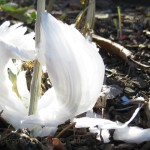
Such complexity and beauty
In a simple form
But only cold conditions:
Winter and Autumn.
The sap in the stem escapes
Thin cracks will form
Then water is drawn
It touches the air
Ice petals will form.
That is how an ice flower is born.

Ravishing and rare
Not found everywhere
Of course green plants can create
Yet also on wood, a fence or a gate
Where water comes through the gate’s pores
The forces push this delicate cause.

So tempting to touch
But wait, don’t rush
Ice flowers will break.
Don’t make the mistake
Instead snap your lens
For the longest keepsake.


Destructive Floods  by Charlie
(Whitfield State School)13 Destructive Floods

Life needs water to survive.
It’s nature’s way to give and provide.
But floods can cause rivers to rise and rise.
Like tears that well-up in our eyes.

Flooding water’s might and power
can crush us like a flimsy flower
and cut its way through rocky land.
Beware flood’s harsh destructive hand.

But floods can have a positive side.
Spreading water far and wide.
Giving plants a long life-span.
Helping heal the dried-up land.


Water Worldwide  by Jonathon
(Whitfield State School)

Cascading into Consciousness by Sharon Davson

Cascading into Consciousness by Sharon Davson


Water glistens, shiny and clear.
From every stream runs Earth’s long tear.
Its floods can cause a lot of strife
and yet it is the gift of life.


Water problems happen worldwide.
With too much water many have died.
With too little water; nothing lives.
So water takes and water gives.


Dripping Icicles  by Jimin
(Whitfield State School)11 Dripping Icicles


Icicles shimmering, clear and cold.
Icicles glistening, standing out bold.
They hang in all sizes from short and long.
Brittle and fragile, but also strong.


When icicles melt, then puddles will form
when winter is done and the weather turns warm.
Dripping in rhythms and plopping in rhyme
they’ll come back again … another time!


Dewy Dewy Droplets  by Coby10 Dewy Dewy Droplets
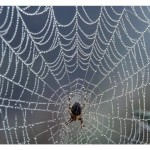
(Whitfield State School)

Dewy, dewy droplets
sitting on my chair
condensing little water bubbles
from the humid air.

Shiny, dewy droplets
catch the morning sun
scattering sunshine everywhere
from each and every one.

Dewy, dewy droplets
cold upon my feet
trickling into water streams
from my body heat.

Diamond, dewy droplets
on a spider’s thread
strung in tiny teardrop shapes
spread rainbows on my bed.


Fragile Icicle Flowers  by Hannah
(Whitfield State School)Ice Flower design

Ice Flowers made of H2O
don’t need the Sun for them to grow.
Ice Flowers form at the base of some plants.
It seems they appear simply by chance.

When soil is moist and night air cold
capillary action takes a hold.
As water rises from the earth
it freezes, making flowers birth.

Ice Flowers are shining bright
as the mystical moon casts its light.
Each tiny icicle curves and squiggles,
creating those flowery waves and wiggles.


Winter Wonders  by Hannah8 Winter Wonders
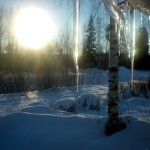
(Whitfield State School)

Up you look, up you look.
Identical icicles all in a row,
Watch them melt.

Down you look, down you look.
See super shimmering shiny snow,
All around.

Six-sided crystals in H2O
Where white winter wonders
Feel “Ho! Ho! Ho!”


A Solution for Life  by Sukarma Rani Thareja & Celia Berrell

I am water.7 A Solution for life
I am in your cells.
I am your friend, not your enemy.

Two hydrogen atoms
and one oxygen atom
make up my molecule.

Two hydrogen bonds between molecules
are my special feature,
benefitting all life’s future.

Though I can be recycled,
you pollute me faster than
I can be cleaned by nature.

In my purest form
I deliver health and happiness
to humans, animals and plants.

But unclean water
delivers death and sickness
with no choices; without exceptions.

So please save me from pollution.
My gift is then life.
The best possible solution.


Be Like Water  by Moona Perrotin

Water flows, it dissolves and lubricates.Be Like Water small
Water holds the world together in a cycle
of rain, ice, snow and river flow.

As mist it rises, as fog it conceals.
It can form clouds and rain down
gathering in streams that flow into the sea.

Lakes create abundance via edges of reeds.
Muddy ground brings forth fish, tadpoles
and insects that feed the birds.

Lake water seeps into the surrounding land.
Creating fertile ground and attracting animals
to drink from the same water source.

Water can bring peace, or be reason for war.
Water reflects the heavens or is tumultuous
like hell.  Water is life-giver.

When too hot the sun shines
water is versatile.
Be like water, alive!


David J Delaney has published four poetry books and has been published worldwide.  He loves travelling around Australia, sharing his enthusiasm for the country’s landscapes in verse. He has also gained significant recognition for his pieces about War Veterans.

Ocean Life  by David J Delaney

Cooling breezes whisper5 Ocean Life
rustling leaves that talk
weathered trees of history
where crustaceans walk

Crystal ocean rolling
shades of blue and green
vibrant coral colours
paint a living scene

Mother Ocean’s stories
moonlight shadows swell
gentle waves are speaking
hidden tales they tell

Vessels, rocking, thrashing
stronger winds now wail
heaving closer daily
ancient people sail

Virgin sands they’re walking
in this morning dew
feasting seafood’s freshness
toasting life anew.


Kristin Martin writes funny poems for children.  When she heard we were seeking science poems about water, she kindly offered to share her poem about the Water Cycle.

A Water Drop’s Adventure  by Kristin Martin

I’d like to be a water drop4 Lizard Clouds
that’s what I’d like to be.
I’d float with other water drops
out in the wide blue sea.

Until, one warm and sunny day
I’d rise into the sky.
You might say I’d evaporate
but I’d say, I would fly.

I’d fly with other water drops;
we’d soar in bath-warm air.
But soon we’d cool, and we’d condense.
So what?  I wouldn’t care.

I’d be together with my friends.
We’d be a big white cloud!
We’d look majestic in the sky.
I’m sure I would feel proud.

The wind would push us tenderly
across the sea to land.
I’d watch the water far below
lap gently on the sand.

But soon we’d reach the mountain range
and float up far too high.
The air would grow too cold for clouds!
We’d have to say goodbye.

Our cloud would have to break apart.
Each drop would meet their fate.
You’d either say we’d fall as rain
or we’d precipitate.

Once on the ground I’d trickle down
until I found a creek.
That creek would carry me towards
the bottom of a peak.

Our creek would merge with other creeks:
a river we would be.
I’d float with other water drops
out in the wide blue sea.

My journey would be at an end
I’d be where I’d begun.
But I could do it all again!
Now wouldn’t that be fun?


Reinhold Mangundu is an environmental activist in Namibia and youth advocate.

Mother Earth  by Reinhold Mangundu

Green and gorgeous, healthy and pretty3 Mother Earth
loving and caring, she made us happy.
Pittering-patter, fell rain on leaves.
Green and bushy the grateful trees.
Flipping their wings, birds sing their salvation
to Mother Earth, the best creation.

Now hold her close
and share your connection.


NatSciWeek celebrations 2017

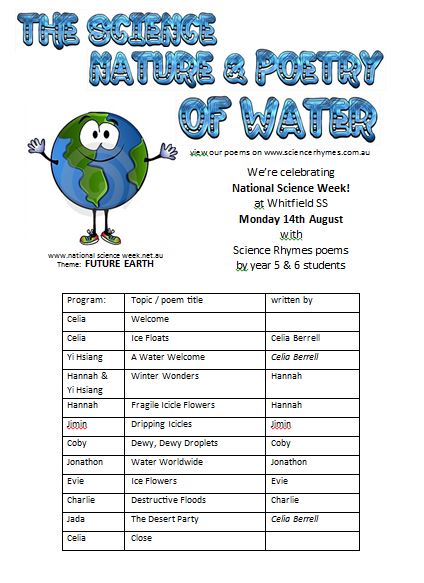
This is it!  National Science Week is here (12-20 August).  On Monday, we have our Poetry Presentation of Science Rhymes at Whitfield State School.  Students from years 5 & 6 have created their own poems about WATER to compliment this year’s National Science Week theme of FUTURE EARTH – as water is important for future life on Earth.  (You can view the student’s poems on the Your Science Poems blog.)

Program SM

Then on Wednesday 16th August, Jonathon and Coby are sharing their poems on ABC Far North Radio, just before the 7am news during BREAKFAST WITH KIER SHOREY.


WATER POEMS PLEASE for National Science Week

2017 is the International Year of Sustainable Tourism. As visitors to planet Earth, how we appreciate and care for limited resources such as water is important for our FUTURE EARTH (which is the school theme for this year’s National Science Week).

Poster NSW Water smaller


At Science Rhymes, we’d love to include your poem about the science, beauty, mystery and/or environmental significance of water as we lead-up to National Science Week in Australia (12-20 August 2017). So put on your poetry hat and take the plunge! Send your H2O poems to feedback@sciencerhymes.com.au.

Click on Weird Water to view two colourful presentations about H2O science.

Here are some links to watery topics chosen by students at Whitfield State School:
EXPLODING H2O: a tiny spark is all it takes …
http://cldfacility.rutgers.edu/content/explosive-reaction-hydrogen-and-oxygen-using-balloons
https://www.youtube.com/watch?v=6gkblppESHA

https://www.youtube.com/watch?v=qOTgeeTB_kA

https://www.youtube.com/watch?v=UV8KbQyF228

https://www.thoughtco.com/making-water-from-hydrogen-and-oxygen-4021101


ICE FLOWERS: flimsy threads and graceful ribbons …
http://my.ilstu.edu/~jrcarter/ice/flowers/

http://js.washingtonpost.com/news/speaking-of-science/wp/2016/12/12/dear-science-what-are-these-strangely-beautiful-ice-formations/?utm_term=.0d3cd98c65bf

http://my.ilstu.edu/~jrcarter/ice/Frost-flowers/


ICICLES: hanging like curtains of chandelier crystals …
https://www.theglobeandmail.com/technology/science/the-mysterious-and-cool-science-of-icicles/article23241318/

https://www.goodlucktripjapan.com/en/article/item/10282/


FLOODS: deceptive and deadly …
http://science.howstuffworks.com/nature/natural-disasters/flood4.htm

http://channel.nationalgeographic.com/u/kcocvFrbKocIXzZvqZkz3KSp5JhYNWr-UZObEg8XG_7K7VoBFZnEzg45DrtvjTHvsiEU3EIZjGI/http://video.nationalgeographic.com.au/video/101-videos/floods

http://www.cairns.qld.gov.au/natural-disasters/flooding/flood-cam


We look forward to receiving your poems!


CAT-A-STATIC about World Poetry Day 2017

21st March, WORLD POETRY DAY “is a window onto the breath-taking diversity of humanity”, says UNESCO Director-General Irina Bokova.  To celebrate, I’ve chosen to share a Science Rhyme  inspired by Nikola Tesla’s story about his childhood pet-cat, the black-Macak.  What sparks your poetic interest?

Cat-a-static by Celia Berrell
(Nikola Tesla 1856 – 1943)

Nicola Tesla's cat MACAK

Nicola Tesla’s cat
MACAK

Nikola loved his childhood cat
the sleek, majestic black-Macak.
A cat whose fur would click and spark
when days were chilly, dry and dark
as stroking black-Macak’s fur coat
could cause a tiny lightning bolt.

Nikola Tesla loved his cat
the sparkling, zappy black-Macak.
That static electricity
inspired young Tesla, cleverly
inventing things quite technical.
Especially electrical.

From neon lights and radios
to radar and remote controls.
Transistors, robots, X-ray zones
and AC power to our homes.
Tesla had a genius knack
that started through his cat Macak!


You can read Nicola Tesla’s short story of his childhood in Yugoslavia 1939 HERE:

” … It happened that one day the cold was drier than ever before. People walking in the snow left a luminous trail behind them, and a snowball thrown against an obstacle gave a flare of light like a loaf of sugar cut with a knife. In the dusk of the evening, as I stroked Macak’s back, I saw a miracle that made me speechless with amazement. Macak’s back was a sheet of light and my hand produced a shower of sparks loud enough to be heard all over the house. …”


Your SPACE Poems 2016

Celebrating World Space Week (4-10 October):

Dr Sam Illingworth is a senior lecturer in Science Communication at Manchester Metropolitan University and regularly writes poetry (including rhyming verse) about the latest science news! Mars rover Curiosity has been drilling holes in Mars rocks and its findings suggest that an ancient Martian lake evaporated, leaving deposits that eventually became like veins in the rocks below.

The Veins of Mars  by Sam IllingworthVeins of Mars

Your crater stands abandoned in the dirt,
As thirsty dreams evaporate for good;
Beneath your dusty surface pressures spurt,
Leaving behind deposits in the mud.
They burn you with their sulphate-silic blood
And your horizons change beyond repair;
Then groundwater appears like a lost flood,
leaving behind pure sulphur in your lair.
We cut you with a knife and steal without a care.


Space extremes  by Marcusspace-extremes
Trinity Anglican School

The planets are spinning without a sound
as gravity swings those comets around.
While meteors smash and bash our planet
made from iron and rocky granite.

The core of the Sun’s fifteen million degrees
while Uranus has the coldest freeze.
It’s a race of extremes out there in space.
And the race in space is at a pace.


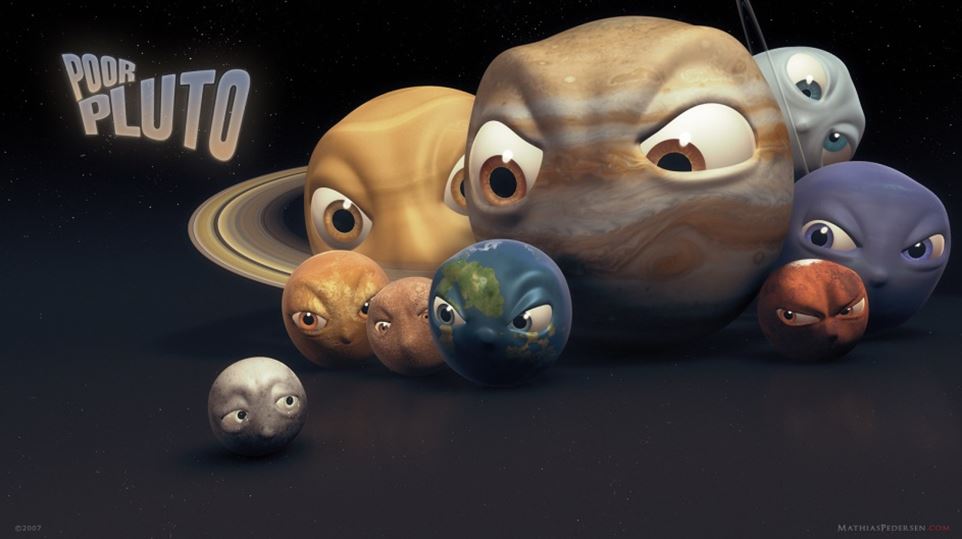
Poor little Pluto  by Isaacpoor-pluto
Trinity Anglican School

Poor little Pluto
blue and sad.
But while he is sulking
he’s secretly mad.

“I’m not a planet!”
Pluto cried.
He just didn’t make it
although he had tried.

He circled the Sun.
Round and round.
A tick in that box.
He nearly was crowned.

Next test was simple.
He was small
but had enough gravity
to stay in a ball.

Here comes the problem.
Five large moons:
Charon, Styx, Kerberos
and secretly Troons.

Poor little Pluto
blue and sad.
These are the reasons.
I guess it’s too bad.


Celia adds:

pluto-moons
Moons cause a problem.
There’s five in the mix:
Charon, Styx, Kerberos
Hydra and Nix!


Sparkling Sun  by Myurisparkling-sun
Trinity Anglican School

Sparkling Sun:
shining and fiery it bubbles and swirls
with dark cold patches while others around it
continue to twirl.

Mini Mercury:
smallest in the family, fastest runner
with extreme mood swings from a wintery cold
to a sizzling summer.

Violent Venus:
boastfully beautiful, this sparkly sister of Earth.
Cloaked by clouds, two planets comparable
were Venus and Earth.

Excellent Earth:
our Goldilocks planet, not too cold and not too hot.
Thankfully our happy home
in which we trot.

Mysterious Mars:
with a little help from some Techy-smart gnomes
in a few hundred years

this could be our new home!

Jumping Jupiter:
dancing with gases, it whips and whirls.
While its many moons spin
this giant ball swirls.

Stunning Saturn:
seven super rings made from dusty ices.
Spinning like a sparkling halo
her beauty entices.

Unique Uranus:
tilted on its side, the coldest light blue.
Discovered with a telescope.
Could we live there too?

Native Neptune:
dark navy blue, it’s running round lazily
far from the Sun
the second coldest in our family.

Peaceful Pluto:
the most famous dwarf planet, floating through space
this tiny ball of ice yearns to be a planet …
but had no case.


The Moon’s a Sickle  by Tomsickle-moon
Trinity Anglican School

The Moon’s a sickle
curved above the evening Sun
in a drowsy day.

When it rises
its beauty fills the land with joy
and owls come out to play.

If you look up at the Moon
you’ll see a kangaroo
engraved upon its face.

Some say it’s made of cheese
but I’d say not!
It’s a ghostly pretty place.


Meteor  by Robinmeteor
Trinity Anglican School

A meteor shower came storming
when planet Earth was forming.
One was nudged by larger rocks
and pushed off-course with bumps and knocks.
Eons later, back to Earth, that meteor would be coming.

When roaming dinosaurs were about
they ruled the Earth.  There was no doubt.
That meteor was not their friend.
With no warning of their nearing end
there was a most humungous crash, which wiped them all out.

Now when I look up to the sky
I wonder if that’s how our race will die.
Or will we work out a clever way
to deflect that meteor far away.
Before it comes whooshing by, anything is worth a try!


Four Gassy Planets by Kirafour-gassy-planets-2
Trinity Anglican School

The biggest planet of them all
looks like a big stripy ball
with sixty-seven circling moons
Jupiter is … a gassy balloon.

Saturn has such startling rings.
I wonder if those rings can sing?
Made from many icy rocks
broken into tiny chunks.

Uranus is the coldest planet.
It says so on the internet!
This planet’s rolling on its side
and fifty thousand kilometres wide.

Is pure blue Neptune a ball of ice?
They say it’s gas, which would be nice.
The farthest away for us to view …
perhaps it’s blue all the way through.


Terrestrial Planets  by Tammyterrestrial-planets
Trinity Anglican School

Today I’d like to share with you
a little of my wisdom.
Some, you’ll know, some may be new
about the Solar System.

The planet closest to the Sun
is Mercury.  An iron ball.
It has no moon to look upon.
It’s rocky and terrestrial.

Venus is a steamy planet.
Its moons, the Sun has pushed away.
Clouds are made from sulphuric acid.
A third-of-a-year is a Venus Day.

Is Earth the only liveable planet?
It certainly is the next in line.
Liquid water will permit
our life-forms, which is fine.

Finally, a small red planet.
You guessed it.  It’s called Mars.
The last of the planets terrestrial.
Surrounded by the stars.


Exploring the Solar System by Jordiexploring-the-solar-system
Trinity Anglican School

Out in the depths of lonely space
some planets are humongous.
Compare their size to asteroids
and they’ll look like spores to fungus!

Mercury is the closest in
and also the hottest planet.
It has a heavy iron core
then lots and lots of granite!

Jupiter is the largest
with a hurricane red blister.
It also has no surface
(so that’s where I’d send my sister!)

Uranus is the coldest
and its name has made it famous.
It’s easy to make fun of it …
so poor, poor Uranus.

Pluto is the tiniest.
And to Pluto I would say
“You’re not a dwarf planet to me …
Honestly, you’re okay!”


My Planet Haikus by Taylaplanet-haikus
Trinity Anglican School

It orbits quickly
around our majestic Sun …
Mercury of course!

Then there’s our sister.
The bade Goldilocks planet …
that’s steamy Venus.

Here is quite nice
if you need a little spice …
Earth is our planet.

I love the next one.
It’s flying among the stars.
It’s just planet Mars.

Here comes Jupiter.
The gargantuan planet.
It is enormous.

Sparkling Saturn
with circling icy rings.
The second largest.

It’s a pale light blue.
Do you think you can guess who?
Floating Uranus.

Blue Neptune is dark.
That’s not because it is sick …
And it’s NOT a Smurf!


The Solar System is Cool  by Louisthe-solar-system-is-cool
Trinity Anglican School

The Solar System is cool.
It spins round the Sun like a spool.
Sun gives light to the planets
their moons and the comets.
Our Soar System is cool.

The Asteroid Belt is sweet.
This ring of rocks won’t stay neat.
Some visit the Earth
(we’re not sure where they birth).
The Asteroid Belt is sweet.

Saturn’s rings are very pretty.
They look a bit like confetti.
They’re made of ice-dust
and ground rocky crust.
Saturn’s rings are very pretty.

SUNDAY 9th October PARTY

Our second Picture-Book Poetry Party was at Rydges Tradewinds Resort, 137 Esplanade, Cairns on Sunday 9th October from 2-3pm. It’s like Book Week meets National Science Week … with a poetic twist!

Poetry Party Poster image


This year’s feature author was Trudie Trewin with her picture-book Calpepper’s Place. As well as hearing an accomplished published author read some of their own work, we had the opportunity to learn aspects of Trudie’s writing journey as well.

Bringing your own Picture-Book entitled you to go into the draw for a book voucher from Collins Booksellers Smithfield.

This FREE event of Storytelling and Science Rhymes happened during World Space Week. Students from Whitfield State School recited their poems about Flight and Trinity Anglican School students shared their passions for Space and our Solar System. It’s was a cosmic event!

You can:

Hosted by Science Rhymes & Rydges Tradewinds, we plan to do it all again next year!

Please email celia@sciencerhymes.com.au to confirm your attendance and/or ask any questions about the next event.

Your Poems 2016

Flight and the Environment feature in this year’s poems:

Feathers for Flight  by Harmonie
Whitfield State School

Birds are feathered, birds are lightFeathers in Flight
Their wings are wide; their legs are slight
Their eyes give them superior sight
But how does this all aid their flight?

Their contour feathers catch the breeze
And help them ride the draught with ease
Some pretty plumes are made to please
While down makes sure those birds don’t freeze!

Their feathery wings can fan out wide
In order to assist their glide
But when those feathers want to hide
They come to rest on either side.

Protruding peepers both are set
On either side of a birds head
These eyes don’t see just straight ahead
But each side and behind instead!

My fact-file’s not yet reached its close
To ensure your avian knowledge grows
Did you know that each bird owns
A set of lightweight hollow bones?


My Flying Bubble  by Coco
Whitfield State Schoolflying bubble

Once upon a flying time
Atop my little roof
A bubble gave a muffled chime
By popping with a poof!

Its soapy droplets sprinkled down
And cleaned my jewellery.
And if I was a dusty crown
Now sparkling bright I’d be!


Busy Buzzing  by Ava
Whitfield State SchoolBusy Buzzing work

I’m buzzing past
an apple tree.
You’re stuck in the grass
and can’t squash me!

Gravity
pushes you to the floor.
With wings so pretty
I move much more.

A flower or five
sucking nectar that’s runny
then back to the hive
to make more honey.

When Keeper is through
taking our wax
and honey too
we’ll buzz GIVE IT BACK!


A Long Way From Home  by Jonathon
Whitfield State SchoolLong way from home

The Moon is dipping out of sight.
My spacecraft is currently in flight
orbiting Earth so very high
like a diamond in the sky.

Travelling towards the stars
the only planet in sight is Mars.
But soon my flight must come to an end
so I can spend time with my friends.


Rainbow Birds  by Tabitha
Whitfield State Schoolrainbow birds

Graceful creatures in the sky
flapping their wings as they fly by.
Circling, soaring into the blue
glimpsing the ground in tiny view.
Glimmering in the sunlight’s kiss.
Radiant in their blue abyss.


In a Flap About Flight  by Evie
Whitfield State SchoolFlight Evie poem small

Although mankind has conquered the skies
with aeroplanes of every size,
despite our best scientific gains
we’ll never fly as well as planes.

It seems our bird-winged counterparts
have the ideal body parts.
A balance of wingspan, weight and strength
makes perfect engineering sense!

Hollow bones are strong yet light.
No wonder they are good in flight!
With an extra air sac on their lungs
a bird breathes better than anyone.

Yes, we humans grow tall and strong
but our weakly wingspan is all wrong.
As much as we’d like to get it right …
humans were never designed to take flight.


Cane harvest kites  by Helen Ramoutsaki

caneharvest kites by Helen Ramoutsaki s


Dr  Sukarma Rani Thareja is an Associate Professor of Chemistry at Christ Church College, CSJM Kanpur University, Kanpur, India.  She took the photo accompanying her poem near her home, depicting the first rays from the morning Sun encountering a pollutant in our atmosphere.

A Pollutant  by Sukarma Rani Thareja & Celia Berrell

An uninvited guest in our atmosphereA Pollutant
touches my face
taunting me.

“When are you leaving uninvited guest?”
I’ll count days on my fingers
and then make a wish.

When I was a child I remember being told
“Don’t cook your tea
with wood on earthen stoves.

Don’t throw garbage onto the roads
contaminate our rivers
like an uninvited guest.”

Now I am old  see through watery eyes.
My footprint ecological
has grown in size.

Somehow I’ve become an uninvited guest.
I’ll count days on my fingers
and then make a wish.


Just over ten years ago, the town of Picher in Oklahoma USA was declared the most toxic place in America. It used to be a lead and zinc mining area, but the region’s natural water supplies became so poisoned with mining waste, the local creek turned red and the town’s residents became ill. Everyone had to leave.  Sarah Roehrig says her new poem, inspired by these events at Picher, is a ballad about the environmental and social impact of mining.


Tar Creek Runs Red by Sarah Roehrigthe-magic-sprig-exmoor-010

Heavy, heavy song.
Rosebuds recycle rain.
Move the people upstream
And the voice of pain.

Repeat, repeat, mountains recoil
Dead like the Queen of the Nile
Pitchers of souls mine the coal
Smile a smile all the while.

The backhoe pulls, rolling right
Cut through the plug
Blood stains the biting clouds
Move the artificial light.

There is no beauty nor rest here
Rivers of blood
Cold mechanical lies
Drag through the mud.

Ashes fall, the fire is lit
One day they will arise
Spirit through bones, rhythm so strong
To hear their troubled cries.


Joel is 25 and believes as long as we stay true to ourselves, we will succeed in life, however crazy it may be. Thanks for sharing this touching environmental poem with us Joel.

Return to What Should Be  by Joel Ewingwater moss

All the tears I’ve tasted
for so many trees we’ve wasted.
It makes me wonder; wonder why
so few of us will ever try
to relieve mankind of ignorance
and shake us from this foolish trance.
Living the way some people are,
every day creates a scar.
Although our Earth is vast and great
at healing, making all things straight,
there’s no time for the world to wait
while we create a toxic fate.
Perhaps one day mankind will see
significance in every tree;
clean rivers flowing to the sea;
with everything as it should be.


Reinhold Mangundu is an environmental activist in Namibia and youth advocate.
He writes blogs and has just started to write environmental poetry too.

A Call for a Cure  by Reinhold Mangundu & Celia

Our world really needs yousunset
to come to her rescue.
To work on a clue
of what we can do.

Our fumes give her fever;
a heat-rising danger.
Her life-blood of rivers
are choking with papers.

We’re losing more species
by chopping her fine trees
so birds are distressed
with nowhere to build nests.

Our world really needs us;
a people that she trusts.
Please work on a clue
of what we can do.


In Conversation – August 2016

For a while there, I imagined I was famous!CB-2 small

Talking with Rob Farquhar about some of the milestones that led to a modest income from my literary passions was a great honour. Rob is a fellow writer and accomplished Paid To Play Podcast host. If you have time, please check it out HERE. I hope we connect along the way – through topics including wild flowers and sci-fi writers, to the life-changing empowerment afforded by a health scare.

Informally, this is the tenth anniversary of my poetic journey which became Science Rhymes.  There’s always a present for you on the Science Rhymes website! My appreciation goes to the network and support received from talented friends and associates of many ages. And the necessary bravery and enjoyment for this interview process was thanks to my participation with Mt Sheridan Toastmasters Club.

PAID TO PLAY PODCAST: Celia Berrell, Science Poet: Episode 92